Dear SLanta

Tuesday, December 23, 2008 Tuesday, December 23, 2008


Dear SLanta:

I haven’t written to you in quite a while, but this year I feel it’s necessary. That’s right, I believe that I’ve been a very, very good avatar all year long. With a few exceptions. Mostly I’ve been good. Well behaved. Usually. No one could question that! Except, well, um. Don’t worry about that, SLanta.

Oh, I clearly deserve some Christmas presents, and just so you have an idea of the items I desperately want, I’ve prepared this short list for you to give to the SLelves. I’d be very happy if you managed to get me one of them, but even happier if you sent me more than one, especially if you send all of them!

  • A software fix for those fatal graphics errors that occur all too often to the SL Viewer on my Mac. They always seem to happen at precisely the wrong time. I’m so glad my friends understand when I abruptly disappear in the middle of a deep conversation.
  • A reduction in Linden Lab tier fees - not so much for me, but for all those who were adversely affected by increases. Well, yeah, I’d like some too if you’re handing them out.
  • More customers! I get quite a few customers showing up at my shop, but I can always use a few more. In fact, SLanta, if you need some snow, I happen to have some you might be interested in. Drop by Electric Pixels and I’ll give you a deal!
  • I want the guy with the oddly-shaped 208 sm parcel smack dab in the middle of my property to reduce his price from the outrageous L$35K (that’s L$170.00+ per sm) to something, anything more reasonable. SLanta, believe me when I say that he’s been a very naughty person. In fact, why not just give me the parcel! Yeah!
  • More time in the day. I realize that everyone will be asking for this one, but I really, really need this one more than anyone! I have so much to do, so many people to see and so many places to visit that I must get more hours. SLanta, I know that this one is asking a lot from you, but I believe you can do almost anything. Please!
  • Tickets to SLCC 2009 for all my friends who were unable to make the 2008 episode. Nothing could make me happier than being able to meet my close friends in person, and SLCC 2009 would be a terrific place to do it. And you can come too, you wouldn't be out of place!
Thanks again, SLanta, for your consideration of my meager requests. I know you can do it! I’ll leave a cookie for you.

It’s Not Nearly As Bad As They Say

Friday, December 19, 2008 Friday, December 19, 2008

There’s been extra helpings of doom spooned out at the dinner table of late. Blog posts complaining of this problem or that issue. Residents leaving. Bad press. More bad press. Linden staff leaving under suspicious circumstances.

We’re doomed! Give Up Now! Run away!

I disagree. Strongly.

As far as I can tell, the universe is unfolding as it should, and I have evidence suggesting that things are indeed going to be much better in the near future. Second Life is a grand experiment, a new technology unleashed upon the world, and as such it must pass through several distinct phases. My RL friend Jackie Fenn, VP of Emerging Trends at Gartner, described these phases in a precise manner. It’s called “The Hype Cycle”. (Note: I just discovered Jackie has written a great article on precisely the same topic as this blog post yesterday, even though I had already written but not yet posted this article, sigh.) This is the Hype Cycle:


The phases are as follows:

  • Technology Trigger: The initial period after a technology is invented, where typically very few people know about it.
  • Peak of Inflated Expectations: After a technology is introduced, many people soon realize its POTENTIAL and assume the technology is sufficiently mature to hit that potential immediately. During this phase you typically see many mass media articles touting the amazing things that COULD be done. After reading these articles, some individuals and companies actually attempt to do them, too. Many of them fail.
  • Trough of Disillusionment: Of course, the technology is still new, not only in terms of its raw capability, but also of its users ability to know how and what to do with it. Typically the majority of keen users, initially attracted by the positive media blitz during the previous phase crash out as their projects and activities do not meet their overinflated expectations. Word of these failures is passed around and a general malaise over the technology occurs. You start seeing a negative media blitz. It’s just bad stuff; run away quickly! You’d have to be crazy to do that! There’s something better over there!
  • Slope of Enlightenment: While the majority of users fled, some stay. Their perseverance yields discoveries that show how to really use the technology properly.
  • Plateau of Productivity: Over a long period of time, their successful new enlightened approaches find their way back to the majority of users and increasing numbers of people find great use of the technology. Potential IS finally achieved.

Does this really happen? Yes, absolutely it does. Virtually every technology follows this sequence of events. “It’s a great idea; It doesn’t work; Oh, maybe it does!” It’s a learning scenario for the public at large. I’ve personally observed this effect happen to many different technologies over the years. It’s definitely real, and Gartner actually tracks the exact phase of dozens of technologies along this very curve.

The question is, where is Second Life on this curve? I pondered different techniques for measuring this, but eventually realized it’s pretty easy: Google Trends provides the answer. (Aside: it's the same technique Jackie used in her article.) Google Trends shows a graph of the proportion of searches for a term over time. If we check the search trend for “Second Life”, we get this:


And amazingly, we see a massive peak in early 2007, just at the moment when many people and companies arrived. You may recall seeing dozens of positive media stories about SL during that period. We then see a huge drop-off in searches for "Second Life", suggesting that more people became disillusioned with the technology. You may also notice the numerous negative articles more recently. This is as classic a case of Hype Cycle as could exist. Also, the graph probably matches your feelings toward Second Life over the same time period; it does for me.

Notice on the right hand side of the graph we see the beginnings of an upturn, precisely as the Hype Cycle predicts. Could this be due to the recent actions of M Linden? The gradually-more-stable software? The amazing resident builds? The rise of educational use of Second Life? I can’t say, but whatever it is, there’s a plateau starting to grow.

You may ask about OpenSim and say that many are fleeing to it, leaving Second Life forever. I don’t doubt that some have indeed left, never to return. But let’s find the search trend on “Second Life” vs. “OpenSim”:


As you can see, OpenSim Doesn’t Even Register! Yes, people are leaving, but clearly they are a tiny proportion. The general public has simply no idea what OpenSim is at this point, and those using OpenSim might be called pioneers. If you were to rank OpenSim, it’s probably earlier in the Hype Cycle, starting to head up the Peak of Inflated Expectations. The implication is that at some point people will get disillusioned with it, too.

For fun I also checked the trend of “Virtual Worlds”, and found that it does register, but only just.


The plateau I speak of may not actually be Second Life itself; it could very well be OpenSim as users are introduced to the concept of virtual worlds via Second Life, but then realize there are other options. Today the general public tends to use the words “Second Life” instead of the more generic “Virtual Worlds”. We’ll have to watch these trends carefully over the next year or two.

There’s another interesting aspect of the Second Life trend graph. It more or less seems to match my in-world store’s revenue stream. There were a lot of sales until late 2007, and then things mysteriously dropped off. Only now are they beginning to recover for me – just as the plateau is emerging.

So stop frowning and try to smile; things are definitely not as bad as they say.

Who Knows You?

Sunday, December 14, 2008 Sunday, December 14, 2008

I’ve been watching two entirely different but strangely parallel ongoing events in recent weeks. What events am I referring to? First, it’s Crap Mariner’s TunesInSL campaign, which is intended to promote many of the wonderful SL-based musicians. The other is Eshi Otawara’s announcement of her new fashion line.
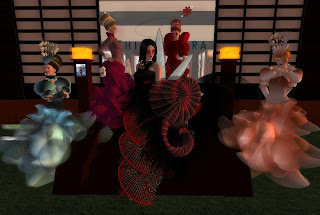
(Photo courtesy Chimera Cosmos)

Now you might wonder what on Earth these two radically different activities might have in common, other than they are being done by two very close friends. The common factor is that they are both promoting something. Fashion products in one case, musicians in the other. Both are following a complex process to meet a difficult goal.

This got me thinking about what it means to promote something in a business sense. At the root of it, there are only three steps involved:

  • Make a large group aware of your “thing”.
  • Make sure that interested individuals consider your “thing”.
  • Ensure the very few individuals who decided to take part actually can (by purchasing, for example)

Ah, but they are not very simple steps. There are specific methods of achieving each of them. In this post, let’s look at the first one, Awareness, which turns out to be the most difficult – but also has the biggest opportunities for creative solutions. How do you make people aware of your “thing”? Here are the main ideas an SL business can consider, although there are likely a few more:

Blog posts. Many SL makers have an accompanying blog in which they can post the details of their new product.
  • Example: I do this now and then. 
  • Positives: a blog post is hugely rich and can include significant text, images and even videos and can potentially reach a lot of people. 
  • Negatives: Few will read a blog solely for product announcements, and you’ll have to commit to a significant amount of high quality writing.

Notecard. Notecards are not nearly as rich as a blog post, but can be useful if carefully worded and sent to a group of friends.
  • Positives: Almost assured delivery to each recipient; can be perceived as a personal message. 
  • Negatives: Can be perceived as SPAM by some recipients; Typically low numbers of people can be reached compared to other methods.

Group announcement. A well worded announcement can be sent to a group, either a true SL Group or a Subscrib-O-Matic group.
  • Positives: Those who subscribe are more likely to partake of your offer than the general public, as they’ve previously expressed interest in your activities; Potentially large numbers of people can be reached. 
  • Negatives: The message sent is not nearly as rich as a blog post, and in some cases is severely limited in size.

Advertising.  This involves somehow visibly placing your product name in a place where many people will see it.
  • Example: SL classified ads. 
  • Positives: Massive numbers of people can potentially be reached 
  • Negatives: Expensive if you want it to be effective; Very complex to understand how to do this properly; Creation of effective advertising material is really hard to do. (I think I’d better go deep on this in an upcoming post.)

Promotional idea. This one is a little vague, as I mean any kind of game or contest that can be associated with your product. The possibilities here are as endless as your imagination.
  • Example: Grid-wide hunt. 
  • Positives: These can be incredibly successful. 
  • Negatives: These can go catastrophically wrong. You must have tremendous imagination and effort to attempt to do a successful promotion.

Show Appearance. A podcast interview or an appearance on a popular machinima show can make many aware of your product.
  • Example: I appeared on SL Under the Radar a while ago.  
  • Positives: This medium is vastly different than all the others and so you can portray your story in a unique way. 
  • Negatives: Show audiences vary considerably, but in all cases few people actually know how to view/listen to them, and thus the potential audience size is limited.

Microblog. Twitter and more recently Plurk offer ways to announce your message.
  • Positives: Extremely easy to do, and no cost at all; Large, dedicated audiences are potentially available. 
  • Negatives: For one, you get only 140 characters, so there’s only so much you can say; You must gain the trust of a large number of people, and that can be very difficult and time consuming, especially if you’re not trustworthy!

Mass Media. You somehow manage to get into one of the major media outlets (press, magazine or TV).
  • Example: Crap Mariner’s CNN iReport. 
  • Positives: Massive number of eyeballs on this one. 
  • Negatives: Extremely hard to do, and usually out of your control entirely (with the exception of the CNN iReport concept.)

Event. This approach is commonly done by many SL business in the form of a product launch, fashion show or opening party.
  • Example: Eshi’s fashion show where she unveiled her new line. 
  • Positives: Moderately easy to do; Usually effective in bringing good amounts of traffic your way; Fun! 
  • Negatives: Can be expensive, depending on what you do.

Forum Post: Discussion boards are a great way to post a message viewed and responded to by many people.
  • Example: Crap Mariner's SLBuzz posting. 
  • Positives: Very easy to do; potentially large audiences available. 
  • Negatives: Unless you have the trust of the audience, you will be ignored.

Press Release. A concise method of documenting your announcment.
  • Example: Codebastard Redgrave’s press release on her new filtercam product. 
  • Positives: Appears very professional; Relatively easy to produce. 
  • Negatives: Awkward to include video; Who do you send it to? PR services that can send it to many for you are expensive, otherwise it’s just a specially formatted blog post.

Each has their advantages and disadvantages, mainly in the effort-to-effectiveness ratio. It’s been my experience that best results occur when you use multiple techniques on the same campaign, and even better results when you link them together into combination approaches, like this:

You issue a press release on a blog regarding an upcoming event to reveal new product lines. The announcement is echoed on all microblogs, and the text is sent by notecard to relevant groups. Appearances on several shows prior to the event raise the event’s profile, as do strategically placed advertising signs. At the event, door prizes keep people talking, guessing and anticipating.

You can see that there is quite a bit to the seemingly simple task of making people aware of your product. Next time, we’ll talk about what you do after that.

By the way, you can find Eshi's amazing collection at her store, Chambre du Chocolat.

After Much Debate

Sunday, December 7, 2008 Sunday, December 07, 2008


Yes, I’ve made a decision. And it’s why I haven’t been posting this week. I’ve been shopping – for land.

My main shop is located on mainland in the Caso Milo region, and has been unchanged size-wise since June 2007. However, I’ve been gradually filling it up over the past eighteen months with products, displays and even a rather wacky lounge. I’ve even begun to worry about prim counts, something I’ve never had to do before.

Last week I noticed a few parcels adjacent to me on sale! After much debate (hence the title of this post) I decided to expand onto mainland instead of getting into the island game. The bottom line was that I just could not justify the expense of an island without having a solid approach for a return on that investment. In other words, I could not think up a way to actually use the land on an island effectively. Sure, I could USE the land, but would I get any RETURN from it? A business does not last long if it spends without returns.

Besides, as everyone knows, islands are a risky proposition if you are not willing to fund it from your own pocket. You must have a substantial income from your business, massive donations, subsidies or a complete complement of renters. None of these are guaranteed, and you’ll have to work very hard to make sure they come through. Worse, there are no guarantees that tier rates will remain stable, as we’ve seen recently. So I proceeded to engage something I know I can afford and make good use of. A bigger mainland shop.


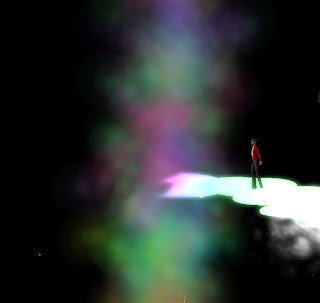
After some quick “buys” and “joins”, my parcel is now almost twice its original size, as you can see in the top image. One issue is that I did not quite get all the space nearby. There was a 256 sm parcel subdivided into a 208 sm and several 16's. I'm negotiating for the 16's, but the 208 sm is priced at the ridiculous price of L$25,000+, if you can believe it! It's using some kind of automated script to gradually lower the price. Fine, I will build around it, and I've placed some particle stanchions around it to keep people from falling to their death below.

Meanwhile, I have obtained significant space that can be used for a variety of purposes. The question now is, “what exactly will I do with this extra space?”

My goal is to rectify an ongoing issue in my particle business: sales seem focused on very basic items, such as chimney smoke, white fog, fire and a few other staples. Meanwhile there are many other fascinating particle effects that don’t sell as well. I have pondered this for a while, and now have a theory that I can test with the new land.

The theory is that unusual particle effects are very difficult to understand, and simply cannot be sold from a box picture or even a basic small-scale demonstration. People already understand smoke and fire, so they buy them. They don’t understand the more unusual products, so they don’t buy them. I sell many strange star effects, but I believe the reason they buy is because I usually have a parcel-wide demonstration running that people can’t miss seeing. In other words, if customers see products properly, they are more likely to purchase. My job as the merchant is to truly show them what the other stuff is all about. And I could not do it when limited by the space.

Thus, the new area will be used to provide rich demonstration experiences, far more detailed than ever before. For example, I suspect I’ll end up with a gigantic area for showing fireworks effects. And another for dance floor effects. And so on.

So if you don’t see me in the next while, you can find me hidden in the back, building demonstrations!

I Feel an Eruption Coming!

Monday, December 1, 2008 Monday, December 01, 2008

The holiday season is approaching, and I wondered what kind of new particle effect to build for the busy sales season. I wanted something new, and while tossing ideas around in the Particle Lounge with friends, we noticed one of the strange effects beside us, Rainbow Smoke. 
 
The Rainbow Smoke is quite cool, but definitely not a holiday item. But could it be made into something special? Yes! A bit of red and green color, ornaments, garlands, stars and a bit of swirl resulted in this, the astonishing Ornament Eruption! It’s not exactly a Christmas tree, but the imagery really feels like one.  

And that’s the thing about particle effects. It’s not just the color, motion and textures. It’s how it makes you feel. That’s how I judge success – does it make you feel something? Does it make you feel what was intended? If so, it’s probably just right. That’s how I felt when the Ornament Eruption first went off in my Lab.

One friend said “There’s another holiday, you know!” Thus, I managed to tweak out a Hanukkah version too. There’s just one teeny problem. What is the one, true way to spell Hanukkah? Hannukah? Chanuka?

In any case, if you really need an eruption (and who wouldn’t?) you can get them now at Electric Pixels – and the Hanukkah versions are also available at the Jewish Store.

Second Life, 2015 AD, Part 3

Friday, November 28, 2008 Friday, November 28, 2008


In part 2 of our series, the avatar of the future has deftly teleported to a party to meet his friends.

They were easy to find, as their titles were highlighted. Sometimes it’s best to turn on Social Proximity mode: titles are colored according to your social affinity to them. Close friends are bright red, acquaintances are yellow, those you haven’t met have gray titles and every shade inbetween. The last time you used it was at a Halloween party, where everyone was in unfamiliar avatars and outfits. But that was cheating; it was too easy to identify your friends.

As it was in the past, so it continues in 2015: dancing is a favorite activity for most avatars. But now there’s a difference, a choice in fact. You’re wearing your motion-detecting top, and it allows you to directly control your avatar’s arms. That's become essential these days, as it is just so convenient to operate the HUDs. But you chose not to snap on the legs, so you cannot control the avatar’s legs. That's a good thing, since you are a terrible dancer in RL. You start up a reliable and fun dance animation and join in.

It's just as well, because your lower-body capture unit is not very good. The best ones go all the way to the toes and can detect ankle twists and toe wiggles. But yours is a very inexpensive unit that just gives the basic limb movements. No ankles. No toes. Even if you could dance, it would look terrible.

Your friend is also a terrible dancer, but tonight she seems to have been taking lessons because she’s doing extremely well. Too well, in fact. You suspect she’s using a new dance animation, but you can’t recognize it. You decided to call her on it and ask in voice.

For a moment you reach for the headphones on the side of your desk. But then you remember and stop. Impromptu voice is tremendously easy now because no headphones are required! Software automatically detects voice or sound echoes and digitally eliminates them, freeing ears from the tyranny of hot headphones or ear-numbing buds forever. Volume fiddling has also long since disappeared.

“Where did you get that dance?” you ask, in a South African accent, which you unfortunately left active last night.

She laughs. “It’s not an animation, silly!”

“But you are dancing so well. Did you take dancing lessons? From that Phil guy?”

Miffed, she answers, “Oh, stop it about Phil! There were no lessons, I’m still a bad dancer. I just got a new Dance Assist!”

Now you recall what she’s talking about. It’s not exactly a dancing animation, but works like one. You wear it, and it monitors your movements through your motion-detecting equipment. It takes your awkward (and all-too-frequent drunken) movements and re-interprets them into smooth dance maneuvers. Some of the better ones map the slightest arm or leg movements into basic dance moves, so that the wearer can “compose” a new dance on the fly just like playing an instrument. 

"I love my DA!" She wails.

No wonder she’s dancing rings around you. It won’t be long before standard dance animations are a thing only newbs would use. You decide you’d better go shopping straight away. Or sooner, as you realize that she probably received the Dance Assist from that Phil guy!

Just a Pile of Products?

Sunday, November 23, 2008 Sunday, November 23, 2008

I’ve added some new items to my store in the past few weeks, taking up more space on the product shelves. In fact, a count today revealed that I now have 196 unique products for sale. I’ve talked before about how I arrange the product shelves for shopping ease, but today I want to talk about extra features that every store should consider having.

The issue is that when you have a great many products, things can be confusing for visiting shoppers. Where do they start? What’s different from the last time they visited?  What’s it all about, anyway? Over the past year I’ve developed a few solutions for my shop; they may work for you too.

Problem: How do customers find new items? At first I would simply place a “NEW” sticker onto the appropriate product boxes. That was fine when the number of products is low, but as the number rises it becomes increasingly difficult for customers to make their way through the entire store to find those shiny new items.


Solution: New products are displayed in an area specifically set aside for that purpose. Of course, it should be visible immediately upon arrival to the store. I’ve made such a display at Electric Pixels in Kiosk form. I automatically know when to clean it out, too – whenever it runs out of space for new items, I clean out the older ones.

Problem: How to deliver custom-made items to customers? One can, of course, have them pay you directly and then you hand over the item. But that method can screw up in various ways, not the least of which is incorrect payment amount.


Solution: I’ve created a “Special Deliveries” area, in which I place one-time product boxes containing special orders. I set the floating text to the name of the customer and also set the box for sale at the agreed upon price. A quick IM to the customer leads them to come by and “pick it up” (which really is “buying” it.) This ensures that your transaction log shows more detail than “Give Inventory”. A side benefit of this approach is that while they’re in your store, they just might buy something else, or perhaps bring someone else along with them.

Problem: Depending on the season, there’s different combinations of products that go together. For example, during Halloween you might want scary Vampire items alongside with falling leaves. Or at another time you might want Christmas and winter items placed together. Either that or you force your customers to thread their way through your shop looking for them. Except that they won’t, and you lose the sale.


Solution: Recently I built a “Seasonal” area in which I can display different combinations of products throughout the year. (That is, if I get off my can and actually move stuff around – note expired Halloween items in photo. Sheesh.)

Problem: Visitors are not sure what to do with your products.


Solution: My solution is to build a demonstration area, where I can display interesting combinations of products. It’s not selling anything directly, but instead the purpose is to stimulate the imagination of the customer, which may lead to purchases they wouldn’t have made otherwise. (Pictured: Eureka Dejavu and myself, testing the demonstration area.)

Problem: Visitors don’t know much about your store.


Solution. You could use one of those accursed Landmark givers, but I don’t like their intrusiveness when I shop, and I suspect my customers don’t like them either. Instead, I’ve built an all-in-one gadget that upon a click offers a landmark, group join, explanatory notecards in multiple languages and a link to the website, too. It also tracks visitors and emails reports periodically.

You can see that a store is not simply just a pile of products pasted on a wall or laid out on the floor. I’ve tried to make the shopping experience as simple as possible. You can too!

Related Posts with Thumbnails